Ecclesiastes 3: A Message of Balance and Acceptance
Ecclesiastes 3: A Message of Balance and Acceptance
In the ancient world, the Book of Ecclesiastes stands out as a powerful reflection on the nature of life. The author, known simply as the "Teacher," grapples with the complexities of existence, exploring themes of meaning, purpose, and the fleeting nature of time. Chapter 3, in particular, offers a timeless message that resonates deeply with readers across cultures and generations.
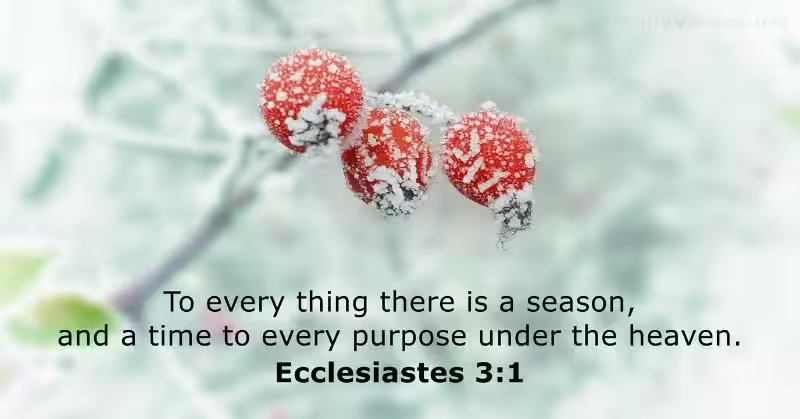
Ecclesiastes 3:1-8 presents a poignant reminder of the cyclical rhythm of life. The Teacher observes that there is "a time for everything, and a season for every activity under heaven." This profound statement captures the essence of life's ebb and flow, highlighting the interconnectedness of seemingly opposite experiences. There is a time for birth and a time for death, a time for planting and a time for uprooting. The Teacher emphasizes the beauty and inevitability of these cycles, urging us to accept them as an integral part of the human experience. The message resonates deeply in our modern world, where we often strive for constant control and struggle to embrace the natural flow of life.
The Wisdom of Accepting Time's Flow
Ecclesiastes 3:9-15 delves into the nuances of our emotional responses to the rhythm of life. The Teacher acknowledges the complexities of human experience, noting that there is a time for "love and a time for hate, a time for war and a time for peace." These contrasting emotions are not necessarily negative; they are inherent to the human condition. The Teacher encourages us to engage with these emotions in a balanced way, recognizing that each has its place in the grand tapestry of life. He instructs us to enjoy the good times while respecting the inevitability of the bad.
Furthermore, the passage emphasizes the importance of finding satisfaction in the present moment, rather than dwelling on the past or striving for an unattainable future. The Teacher cautions against chasing after "wind," a powerful metaphor for fleeting pursuits that ultimately leave us empty. Instead, he encourages us to embrace the beauty and wonder of the present, recognizing that each moment is a gift.
The final verses of Ecclesiastes 3, verses 16-22, offer a profound reflection on the limitations of human understanding. The Teacher acknowledges that we are limited in our ability to fully comprehend the intricate workings of the universe. We may not always understand why things happen the way they do, but we can find comfort in knowing that there is a divine order to everything, a "time for everything" that is ultimately beyond our control. We are called to trust in the wisdom of the universe and embrace the mystery that surrounds us.
Ultimately, Ecclesiastes 3 offers a powerful message of acceptance and balance. It encourages us to embrace the natural flow of life, recognizing the beauty and inevitability of its cycles. The message reminds us that there is a time for everything, and that by accepting the present moment, we can find true joy and satisfaction in our journey.