In the tapestry of the Bible, names often hold significance, weaving threads of history, lineage, and divine purpose. One such name, Esrom, appears in the book of Genesis, a name that may be familiar to some but whose story often goes unnoticed. Esrom, the son of Pharez and the grandson of Judah, holds a unique place in the biblical narrative, representing a lineage that would ultimately lead to the birth of Jesus Christ.
Esrom's name itself is rich in symbolism. It is thought to be derived from the Hebrew word "esrah," meaning "to bind" or "to tie." This interpretation aligns with the story of his father, Pharez, who was born through a complex situation involving Tamar, Judah's daughter-in-law. Pharez, meaning "to break through" or "to burst forth," overcame adversity and ultimately became the father of Esrom. This duality of "binding" and "breaking through" suggests a lineage that would both endure and overcome obstacles, paving the way for the fulfillment of God's promises.
Tracing the Lineage of a King
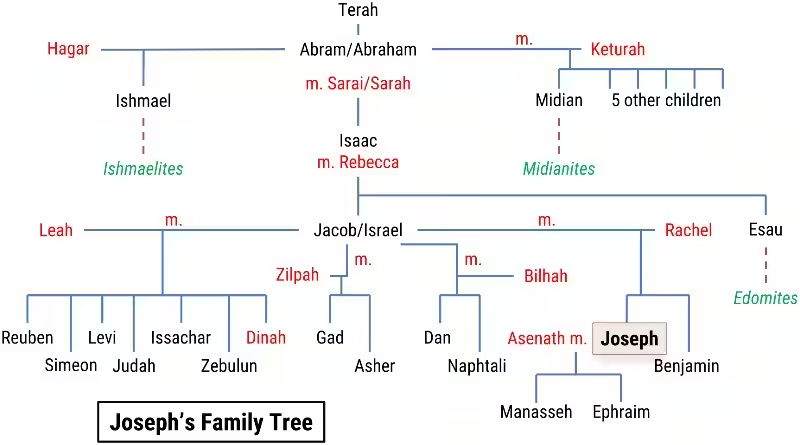
Esrom's lineage is essential to understanding his significance. His father, Pharez, was one of the twin sons of Judah, the fourth son of Jacob. Judah's descendants were destined to play a crucial role in God's plan, as the tribe of Judah would eventually produce the messianic line. Esrom's place in this lineage is not merely a matter of genealogy; it signifies a connection to a divine promise. His descendants would continue to play a vital role in the unfolding story of God's people.
The importance of Esrom's lineage is highlighted in Matthew's genealogy of Jesus Christ. The lineage traces back to Abraham and ultimately to Adam, but it also includes Esrom. This inclusion demonstrates that Esrom's lineage was not just a historical footnote; it was a vital link in the chain of events that led to the birth of Jesus. Esrom's descendants, through a long and winding path, would eventually lead to the birth of the Savior of the world.
Esrom's lineage is not just a list of names; it is a testament to faith and resilience. Like the Israelites themselves, Esrom's ancestors faced challenges, trials, and triumphs. They experienced periods of prosperity and times of hardship, but through it all, God remained faithful to his promises. Esrom's place in this lineage signifies that even in the midst of adversity, God's plan prevails. His story reminds us that even when we feel lost or insignificant, we are part of a wider narrative, a story that ultimately points to God's love and faithfulness.
Esrom's lineage is also a reminder that God works through ordinary people to accomplish extraordinary things. Esrom himself may not have been a king or a prophet, but his lineage led to the birth of the King of Kings. This underscores the importance of each individual's role in God's plan, regardless of our status or achievements. We are all part of God's story, and our lives, however small they may seem, can contribute to the unfolding of his grand design.