Unpacking the Power of "Behold, I Am the Servant of the Lord": Understanding Luke 1:38
Unpacking the Power of "Behold, I Am the Servant of the Lord": Understanding Luke 1:38
The story of Mary, the mother of Jesus, is a powerful testament to faith and the transformative nature of God's grace. In Luke 1:38, we encounter a pivotal moment in this story, where Mary's response to the angel Gabriel's announcement of her impending pregnancy encapsulates the essence of her faith and her willingness to embrace God's will.
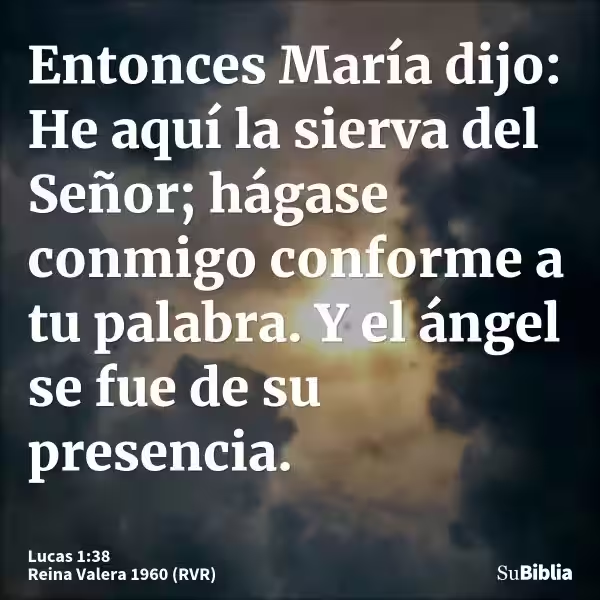
This verse, "Behold, I am the servant of the Lord; let it be to me according to your word," is not just a passive acceptance of fate; it is a profound declaration of Mary's complete surrender to God's plan. Her words echo the spirit of the prophet Isaiah, who proclaimed, "Here I am! Send me." (Isaiah 6:8) Mary's "Behold" is not a mere acknowledgment; it is a declaration of readiness, a posture of humble submission to the divine.
Deconstructing the Meaning of “Behold, I am the Servant of the Lord”
The phrase "I am the servant of the Lord" is a powerful statement of humility and selflessness. It signifies Mary's understanding of her place in the grand scheme of God's plan. She recognizes that she is not the center of the universe but a humble instrument in God's hands, ready to be used for his purposes.
Consider the example of a potter and his clay. The potter, with his skills and vision, shapes the clay into a beautiful vessel. The clay, in its malleability, submits to the potter's will, becoming something greater than it was before. Similarly, Mary, in her humility, submits to God's will, becoming the vessel that would carry and birth the Savior of the world.
Understanding "Let it be to me according to your word"
Mary's statement, "Let it be to me according to your word," is not just a simple acceptance of her pregnancy; it is a profound declaration of trust. She is not simply resigned to her fate, but rather, she trusts God's plan implicitly, believing that his word is good and his ways are perfect.
Imagine a child asking their parent for a gift. The child might have a specific gift in mind, but ultimately, they trust their parent to choose the best gift for them. Mary, in her faith, trusts God as her parent, knowing that his plan, even if it is difficult to understand, is ultimately for her good and for the good of the world.
The Significance of Mary’s Response
Mary's response in Luke 1:38 is a model of faith for all believers. It teaches us the importance of:
Humility: Recognizing our own limitations and acknowledging God's power and sovereignty.
Obedience: Willingly submitting to God's will, even when it is challenging or uncomfortable.
Trust: Having faith in God's goodness and believing that his plans are for our benefit.
Mary's willingness to say "yes" to God, even when it meant facing enormous challenges, transformed her life and the course of history. Her response, captured in Luke 1:38, echoes throughout the ages, reminding us that God's grace is sufficient for any situation and that we too can choose to be servants of the Lord, allowing him to work through us to achieve his purposes.