Endor, a small village nestled in the hills of ancient Israel, holds a captivating place in biblical history. Located in the Jezreel Valley, near Mount Tabor and the Hill of Moreh, its name has echoed through the centuries, wrapped in mystery, spiritual tension, and supernatural intrigue.
The very word "Endor" carries meaning far beyond geography. It hints at a place of ancient power, spiritual conflict, and divine judgment. But what does it truly mean?
What Does "Endor" Mean?
In Hebrew, the name Endor is believed to be a combination of two words:
"עין" ('ayin or 'en) – meaning "spring" or "fountain"
"דור" (dor) – meaning "generation," "habitation," or "dwelling place"
This poetic combination paints a picture of "a spring of generations" or "a fountain of dwelling", evoking a place where life springs forth and generations are rooted. It is both a physical location and a symbolic representation of continuity, presence, and vitality—though ironically, it’s most known for an episode of darkness and spiritual danger.
The Medium of Endor: A Dark Night of the Soul
The most famous (and infamous) reference to Endor occurs in 1 Samuel 28, during a moment of intense crisis for King Saul. Facing an overwhelming Philistine threat, Saul desperately seeks God's guidance. But the Lord is silent—no dreams, no prophets, no answers through the Urim.
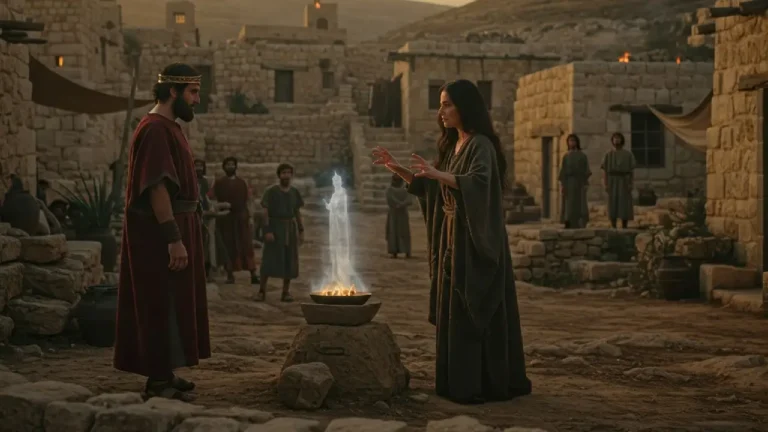
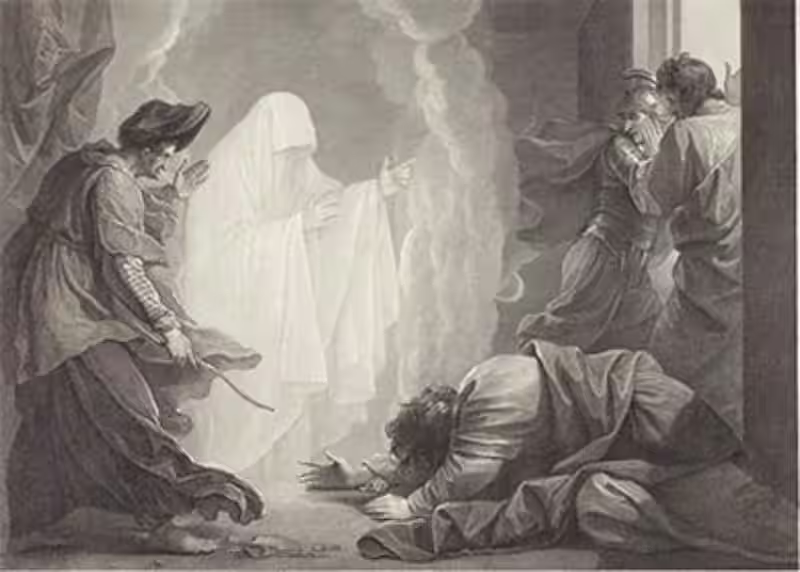
In a state of fear and panic, Saul resorts to what he had previously outlawed: necromancy. Despite having expelled all mediums and spiritists (1 Samuel 28:3), he disguises himself and travels by night to Endor, seeking the help of a woman who can summon the dead.
This woman, often called "the Witch of Endor", is described in Hebrew as: "אֵשֶׁת בַּעֲלַת־אוֹב" (eshet ba‘alat-ov) – a woman who possesses a familiar spirit.
This figure, cloaked in spiritual ambiguity, embodies the dangerous allure of forbidden knowledge. She represents the human desire for answers, even if those answers come through disobedience and occult practices.
The Spirit of Samuel: Prophecy from Beyond
At Saul’s request, the medium of Endor summons the prophet Samuel, who had died. The scene is chilling: Samuel appears and delivers a devastating message:
Saul’s disobedience has cost him the kingdom.
David will succeed him.
By tomorrow, Saul and his sons will be dead.
Israel will fall in battle.
Whether this spirit was truly Samuel, a demonic deception, or a divinely allowed appearance, has long been debated by theologians. But the message is clear: Saul’s actions have consequences, and the silence of God cannot be bypassed through occult means.
Saul sought life from the dead—but found only judgment.
More Than a Tale of Magic: The Legacy of Endor
Though Endor is forever linked to this eerie biblical encounter, it appears elsewhere in Scripture. In Psalm 83:9–10, it is mentioned in the context of Israel’s military victories, notably the defeat of Sisera and Jabin, which occurred near this region.
Thus, Endor is a place of both spiritual downfall and military triumph—a site of paradox. While the story of the medium casts a shadow, the name "spring of habitation" still whispers of hope, continuity, and potential restoration.
Today, many scholars and archaeologists associate ancient Endor with the modern site of Ein Dor or Indur in northern Israel. It remains a symbol of the human struggle between faith and fear, between trust in God and the temptation to seek answers from forbidden paths.
Key Takeaways
Endor means "spring of generations", suggesting life and continuity.
It is most famous for its role in 1 Samuel 28, where King Saul consults a medium.
The story highlights the danger of spiritual compromise in times of desperation.
The medium’s summoning of Samuel's spirit brings a prophetic warning of Saul’s death.
Endor is also referenced in Psalm 83 in the context of Israelite victory.
The legacy of Endor is one of spiritual tension, moral caution, and deep theological reflection.
❓ Frequently Asked Questions (FAQs)
Was the "Witch of Endor" really a witch?
The term “witch” is a later interpretation. In Hebrew, she is a woman with a familiar spirit. She acted as a medium, a person who claims to communicate with the dead—something explicitly forbidden in biblical law (Deuteronomy 18:10-12).
Did the woman actually summon the prophet Samuel?
There is debate. Some believe it was truly Samuel, allowed by God for judgment. Others argue it was a demonic spirit or an illusion. Regardless, the message aligned with God’s previous warnings and came true the next day.
Why did Saul turn to a medium if he knew it was forbidden?
Saul was desperate, abandoned by God due to his previous disobedience. His fear of death and failure led him to violate his own laws, revealing the depth of his spiritual collapse.
Most scholars associate biblical Endor with Ein Dor, a modern kibbutz in northern Israel, near Mount Tabor. Archaeological evidence suggests long-term habitation in the area, supporting this identification.
What lesson does the story of Endor teach?
It serves as a sobering warning about seeking truth in forbidden places. Even in silence, we are called to trust God’s timing and ways, rather than turning to occultism or spiritual shortcuts.
Final Thoughts
The story of Endor is not merely a curiosity of ancient scripture—it's a mirror for the soul. It challenges us to reflect on where we turn in moments of fear and silence. Endor is a symbol of human frailty, but also of the eternal truth that only God's voice leads to life, while the voices of the dead lead only to sorrow.