The story unfolds in Matthew 22:18-22, a pivotal moment in Jesus' ministry. The Pharisees, known for their strict adherence to the Law, had devised a cunning plan to ensnare Jesus. They approached Him with a question concerning the payment of taxes, hoping to expose Him as a threat to the Roman authorities. Their intention was to exploit Jesus' teachings, hoping to find fault in His words.
Their question, crafted with meticulous care, was a carefully constructed trap. "Teacher," they began, "we know You are truthful and teach the way of God honestly. You don't care what people think, for You don't show partiality. Tell us then, what do You think? Is it lawful to pay taxes to Caesar, or not?" Their words, laced with flattery, aimed to disarm Jesus and lure Him into a false sense of security. However, Jesus, with His divine wisdom, saw through their deceptive ploy and responded with a masterful stroke of brilliance.
The Coin of Caesar: A Symbol of Authority
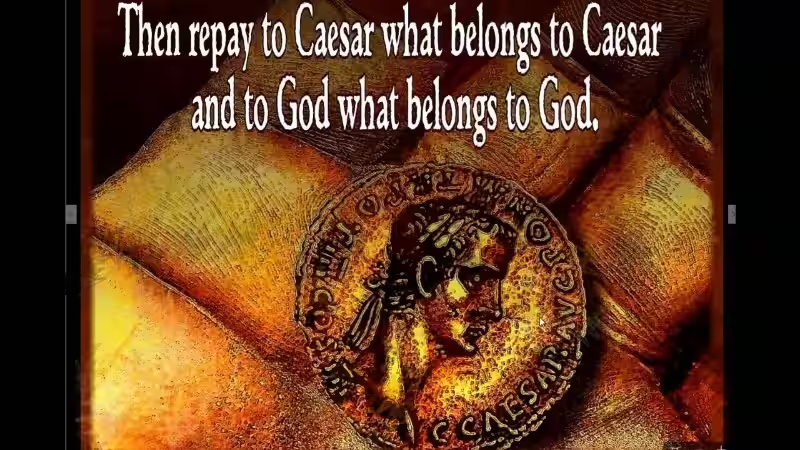
Jesus, realizing their intentions, asked for a coin. "Show Me the coin used for paying the tax," He instructed, knowing the coin would be a tangible representation of Caesar's authority. As they presented the coin, Jesus asked, "Whose image and inscription are these?" The Pharisees, caught in their own trap, had to admit, "Caesar's." They understood that the coin bore the likeness of Caesar, signifying his reign and authority. Jesus then delivered His famous words: "Therefore, render to Caesar the things that are Caesar's, and to God the things that are God's."
This simple yet profound statement was a masterclass in navigating complex situations. Jesus, with His wisdom, recognized that the coin represented a dual reality. It belonged to Caesar, the earthly ruler, but also to God, the ultimate authority. By acknowledging Caesar's authority in a practical matter, Jesus did not undermine the authority of God, but rather affirmed a separation of realms. The coin served as a reminder that there are earthly matters that require obedience, while spiritual matters belong to God alone.
The Pharisees had hoped to trap Jesus with their question, placing Him in a dilemma. If He declared that taxes were unlawful, He would be labeled a rebel against Roman rule. However, if He affirmed the payment of taxes, he would be seen as compromising His teachings and jeopardizing His position as a spiritual leader.
Jesus, however, outsmarted their scheme. He recognized the true nature of their question, not as a sincere inquiry but as a calculated trap. By focusing on the coin and its symbolism, Jesus cleverly sidestepped their trap and exposed their intentions. He demonstrated that both earthly and spiritual realms have their own spheres of authority, and that obedience to one does not negate the other. This response, filled with wisdom and grace, left the Pharisees speechless and exposed their hypocrisy.